Best Practices
Managing DMARC across many client domains brings isolation, access, and billing challenges. Here is how agencies and MSPs handle it at scale with DMARCeye.
For an agency or MSP, the hard part of DMARC is rarely the protocol itself. It is running DMARC as a repeatable service across every client domain you manage, without the workload multiplying with every client you take on.
Most DMARC guidance assumes you own one domain and answer only to yourself. An agency sits on dozens of domains that belong to other people, each with its own DNS, its own senders, and its own tolerance for risk. The protocol is the same for all of them. The operations around it are what get hard.
How Is Managing DMARC for Clients Different from Your Own Domains?
A single business monitors one or a few domains. A large company governs its own domains across business units, which is its own discipline that we cover in Multi-Domain DMARC Governance for Enterprises. An agency has a third problem: it manages domains it does not own, for clients who each expect their data to be kept private, with individualized reporting, and a clean invoice. Agencies are responsible for their clients' email deliverability, and DMARC is the authentication layer underneath it.
What Are the Four Headaches of Managing DMARC for Clients?
Four problems show up once you manage more than a handful of client domains:
- Isolation. One client's reports, sending sources, and alerts must never bleed into another's.
- Access. Your team needs the right people on the right accounts, and each client should see only their own data.
- Billing. Some clients pay on their own card, some you bill centrally, and some you resell in bulk. One rigid pricing model breaks at least one of those arrangements.
- Reviews. Past roughly ten domains, opening each dashboard one at a time for a monthly check stops scaling.
How Does DMARCeye Handle Multi-Client DMARC?
DMARCeye's agency setup maps to each of those four problems. Every client gets a fully isolated sub-account with its own domains, reports, alerts, and team members, and you run all of them from one agency login. Team access is role-based and scoped per client, so clients never see each other's data, or that your other clients exist.
Flexible Billing
Billing is flexible. You can let each client pay on their own card at standard rates, bill every sub-account centrally for a volume discount on total usage, or prepay a pool of domains and emails and distribute it across clients as you sign them. Pricing is per domain, so your cost tracks the number of clients you serve rather than a fixed plan tier. Per-domain pricing also stays more affordable than tier-based tools as your client list grows.
Master MCP
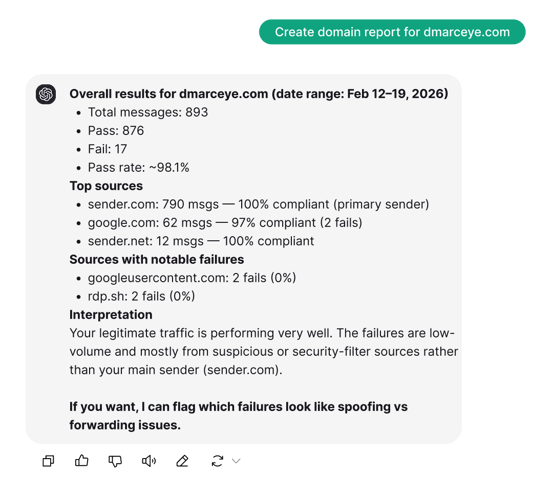
For monthly reviews, you can connect your AI assistant to DMARCeye through its MCP server and ask about the whole portfolio in plain language, for example "which client domains are still at p=none," instead of clicking through each dashboard in turn. The same access scoping applies, so the agency owner sees everything and a client sees only their own domains.
White-Labeling
You can also put your own logo on the app today, with PDF report exports planned, and DMARCeye handles migration and DNS handover with you on a scheduled call. Because the platform tells you what to fix for each domain in plain language, you do not need a DMARC specialist assigned to every account to deliver the service.
Managing DMARC for clients is an operations problem before it is a technical one. The tooling that makes it profitable is the tooling that keeps clients separated, billing flexible, and reviews fast as the portfolio grows. That is what DMARCeye is built to do for agencies and MSPs.